

Revenue-Focused Google Ads Management
Ongoing Google Ads optimization tied to qualified leads (and revenue when trackable) — built for small B2B service budgets that need efficiency, not noise.
-
Weekly optimization with budget discipline
-
Continuous creative + offer angle testing
-
Reporting tied to lead quality / pipeline signals

Built for B2B service firms that care about pipeline quality
This is for teams that want predictable, accountable optimization — and are willing to measure outcomes beyond form fills. If your goal is qualified leads that turn into real pipeline, you’ll feel at home here.
B2B services with a real sales process
This is built for firms that sell expertise—not impulse buys—where leads need follow-up, qualification, and often multiple touches before they convert. If your Google Ads success depends on booked calls, discovery meetings, or sales conversations, this model fits your reality.
Limited budgets where waste hurts
When budgets are tight, you can’t afford “learning” that’s really just burning spend on the wrong intent. We focus on concentrating data, cutting obvious waste, and training Google Ads on signals that matter—so a smaller budget can still drive meaningful pipeline.
Willing to qualify leads consistently
Lead quality improves when it’s measured, not guessed. If you can consistently mark leads as qualified (or not) in a CRM—great. If you don’t have one yet, we can still work with a lightweight process, but consistency is non-negotiable if you want optimization tied to real outcomes.
What's different
Most agencies optimize to clicks and forms. We optimize to what becomes revenue.
We don’t treat Google Ads like a traffic faucet. We treat it like a system that needs the right signals. Our management is built around qualification and measurement integrity, so the algorithm learns from outcomes that actually correlate with pipeline.
What you get with ongoing management
We run a consistent cadence that improves performance without random “tweaks.”
Optimization & efficiency
We manage budgets, bidding strategies, search terms, negatives, and targeting boundaries to keep spend focused on high-intent demand.
Creative & messaging tests
We continuously test new angles (RSAs, assets, extensions, offers) to reduce ad fatigue and improve conversion quality—not just CTR.
Measurement & lead quality loop
We monitor conversion integrity, keep reporting aligned to pipeline signals, and refine what Google learns from as your funnel evolves.
Communication & strategy
You get a clear monthly strategy call and straight reporting on what’s working, what isn’t, and exactly what we’re changing next—so you always know why decisions are being made.
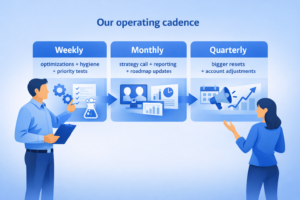
Our operating cadence
Weekly
We keep the account healthy and moving forward with targeted optimizations, hygiene (search terms, negatives, settings, budgets), and a small set of priority tests based on what the data is telling us.
Monthly
We step back to review performance trends and lead quality, deliver clear reporting, and run a strategy call to align on what matters most. You get an updated roadmap so you know exactly what we’re focusing on next and why.
Quarterly
We make larger, higher-impact adjustments when needed—refreshing landing page offers, tightening or restructuring the account, and upgrading measurement so optimization stays tied to real outcomes as your business evolves.
Pricing
Simple monthly retainer
Core Management
$
299
per month
Best for: 1 offer, 1 market, straightforward tracking
-
Weekly optimization + budget discipline
-
Ongoing RSA/asset testing (angle-based)
-
Monthly reporting + strategy call
-
Basic lead quality monitoring
Growth Management
$
399
per month
Best for: multiple services, multiple locations, more testing volume
-
Includes everything in Core, plus:
-
Higher testing cadence (more creative/offer iterations)
-
Deeper segmentation + scaling strategy
-
More advanced pipeline reporting and insights
-
FAQ
1. Do we need the Tracking & Lead Quality Setup first?
In most cases, yes. We start with Tracking & Lead Quality Setup unless your tracking and qualification signals are already clean, consistent, and validated. If Google Ads is optimizing to unreliable conversions (or “leads” with no quality filter), ongoing management becomes guesswork—because the algorithm is trained on noise.
If you believe your measurement is already solid, we’ll confirm it quickly and only propose Setup if something critical is missing.
2. How soon will we see results?
You should expect clarity and efficiency improvements early—cleaner reporting, fewer obvious mismatches, and more confident optimization decisions. Pipeline impact can follow, but timing depends on your offer strength, market demand, budget, and follow-up speed.
In other words: we can control measurement and optimization; we can’t control your sales cycle. If your sales cycle is 30–90 days, revenue impact will naturally lag.
3. What does “revenue-focused” actually mean in practice?
It means we optimize toward the deepest reliable outcome your business can track. For some clients that’s qualified leads; for others it’s booked calls, opportunities, or revenue via CRM integration and offline conversions.
We don’t claim revenue focus while optimizing to surface-level form fills. If the signal can’t be trusted, we fix it before scaling.
4. Do you do landing pages?
We don’t “redesign your site” as part of management, but we do guide landing page performance in a practical way. We identify the highest-impact fixes (messaging, offer clarity, friction, form quality, intent alignment) and propose what to test next.
Implementation can be done by your team, your developer, or scoped with us/partners if you want it handled end-to-end.
5. What do you report on?
We report on qualified leads and pipeline signals first, because CPL alone is a vanity metric in B2B services. Typical reporting includes: lead volume, qualified rate (when trackable), cost per qualified lead, and trend-level insights tied to campaign changes.
Revenue reporting is included when tracking supports it (CRM stages, offline conversions, or reliable deal value data).
6. How do you improve lead quality specifically?
Lead quality improves when three things are aligned: targeting intent, conversion signals, and qualification. We tighten targeting boundaries, remove waste, and train Google Ads on outcomes that correlate with pipeline (not just “someone filled a form”).
If you’re able to classify leads as qualified/not qualified consistently, we can improve the system much faster.
7. Are you a fit for small budgets?
Yes—this is designed for limited budgets. But small budgets need discipline: fewer campaigns, clearer signals, and a focused testing plan. If the expectation is “scale fast with no constraints,” you’ll be disappointed. If the goal is “make this efficient and measurable,” we’re aligned.